Private Pay vs Insurance for Hospital Beds: Why Direct Purchase Saves Time and Stress

Most homeowners handling a hospital discharge quickly discover that a standard policy rarely guarantees a smooth transition. We know that comparing Private Pay vs Insurance for Hospital Beds: Why Direct Purchase Saves Time and Stress is critical for your family’s comfort. The approval timeline is often significantly longer and more restrictive than most families expect.
Our professional service team steps in to help clarify these options every single day.
Let’s look at the current 2026 data, what it actually means for your timeline, and explore a few practical ways to respond.
How Insurance Coverage Works for Hospital Beds
Hospital beds fall under Durable Medical Equipment, which the Centers for Medicare and Medicaid Services classifies as DMEPOS. We know this category comes with strict rules, limitations, and approval hurdles. Medicare conditions must align perfectly for a claim to succeed.
Medicare Part B DME Coverage
Medicare Part B covers basic hospital beds when specific criteria are met. Our experience shows that the paperwork process is usually the biggest bottleneck.
- A physician documents that the bed is medically necessary
- The physician writes a detailed prescription specifying the type of bed
- The DME supplier is Medicare-enrolled and accepts assignment
- The specific bed model is on Medicare’s approved equipment list
- Prior authorization is obtained before the bed is delivered
That final requirement of prior authorization causes the most friction. We consistently see reviews stall for weeks while insurers request more documentation. A 2024 analysis by KFF found that Medicare Advantage insurers denied 4.1 million prior authorization requests. Our team often helps families understand that an initial denial forces an appeals process, delaying comfort even further.
“A 2025 Parachute Health study revealed that 67.9% of U.S. hospitals report delaying patient discharge solely because durable medical equipment is unavailable.”
What Medicare Typically Covers
The standard coverage heavily favors the most basic, entry-level models. We want you to know exactly what to expect if you go this route.
Medicare Part B generally covers:
- Semi-electric hospital beds (the most basic powered option)
- A standard pressure-prevention mattress
- Full-length side rails
Medicare does not typically cover:
- Fully-electric hospital beds (viewed as a convenience)
- Premium luxury features or residential styling
- Specialty therapeutic mattresses beyond basic prevention
- Bariatric models without severe medical justification
- Ultra-low frames without a documented fall risk
A common insider pitfall is misunderstanding the term “semi-electric.” We remind families that while the head and foot sections move electrically, the overall bed height requires manual hand-cranking. Caregivers frequently report back injuries from bending over to crank these heavy beds multiple times a day.
Private Insurance
Private coverage details vary dramatically across different U.S. carriers. We often see plans that mirror Medicare’s baseline rules, while others provide slightly higher allowances. Many homeowners face high deductibles or maximum equipment limits that leave large out-of-pocket bills. Our team always advises checking your specific summary of benefits first. The primary bottleneck across all insurers remains the mandatory physician prescription, authorization wait, and unpredictable delivery date.
Evaluating Private Pay vs Insurance for Hospital Beds: Why Direct Purchase Saves Time and Stress
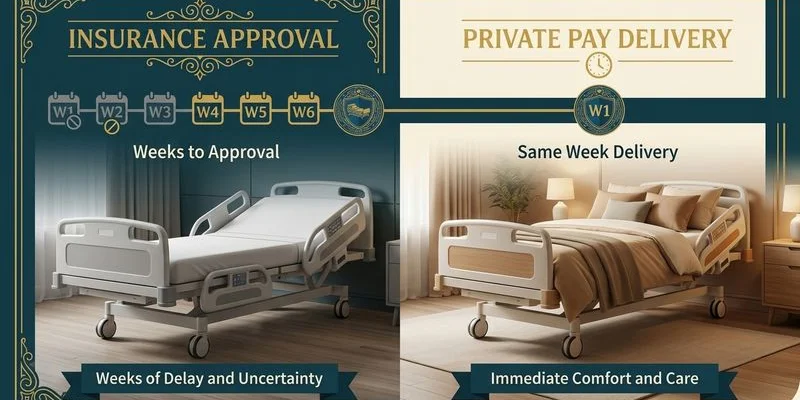
Directly purchasing medical equipment bypasses the entire insurance waiting game. We empower you to select the exact model you want and schedule delivery on your terms. This direct path completely changes the timeline.
| Factor | Insurance Route | Private Pay |
|---|---|---|
| Timeline | 2 to 8 weeks (authorization and delivery) | 1 to 5 business days |
| Equipment Choice | Limited to approved models | Any model, any features |
| Bed Type | Usually semi-electric only | Fully-electric, bariatric, ultra-low, luxury |
| Mattress | Basic prevention only | Any therapeutic mattress |
| Delivery | Standard delivery (no setup guarantee) | White-glove with full setup and training |
| Ongoing Costs | Monthly rental fees (common) | One-time purchase (immediate ownership) |
| Paperwork | Physician prescription, authorization, appeals | None |
| Provider Choice | Must use Medicare-enrolled DME supplier | Any retailer |
Why Families Choose Private Pay
Speed and Immediate Relief
A sudden hospital discharge or an unexpected fall means you need a safe resting place right now. Our direct purchase option guarantees placement within days, sometimes even the next morning. Waiting four to six weeks is simply not feasible for a family in crisis. We see how this rapid response provides immediate peace of mind. Faster delivery directly prevents unnecessary extended hospital stays.
Complete Choice and Control
An insurance catalog restricts you to whatever basic models the approved local supplier carries. Our inventory opens up the entire market for your exact requirements. If a loved one requires a fully-electric hospital bed with floor-level positioning, or a bariatric bed built for a specific weight, the direct route makes it happen. We also stock premium luxury bed options that look like beautiful home furniture rather than clinical hardware. Customization ensures the equipment fits your exact room dimensions.
Complete Simplicity
Skipping the authorization maze eliminates a massive administrative headache. We handle the details without requiring prescriptions, appeals, or confusing phone trees. You pick the ideal setup, and the transaction is done. Our staff manages the delivery logistics in a single, straightforward step. This saves hours of frustrating paperwork.
Outright Ownership
Medicare operates on a capped rental system for most durable medical equipment. We frequently explain to clients that you pay a monthly fee for 13 months before you actually own the frame. During that year, the supplier owns the unit and dictates what accessories you can add or if you must return it. Our private-pay customers own the equipment from day one, allowing total freedom to modify the setup. You decide exactly how long you keep it in your home.
Superior Quality and Comfort
Medicare-approved items meet minimum functional standards and nothing more. We provide access to features that drastically improve daily care and comfort. Private purchases offer quieter motors, therapeutic mattresses, advanced positioning, and residential styling. Our new equipment guarantees a pristine, sanitary starting point. Cleanliness is paramount for patients with compromised immune systems.
Understanding the Real Cost
Direct purchase might look more expensive initially, but the long-term math often favors buying. We break down the numbers to show the actual financial impact. A 2026 market analysis shows that renting a standard full-electric frame costs between $195 and $400 per month. Our financial comparison highlights that the break-even point between renting and buying usually hits around the 6-to-12-month mark. Let’s look at a realistic breakdown.
Insurance Costs (Example)
The monthly copays add up faster than many people realize. We calculate this using the standard 13-month Medicare rental timeline.
- Monthly rental copay (Medicare estimate): $60 to $120 per month
- Rental period: 13 months
- Total copay: $780 to $1,560
- The 2025 Medicare Part B deductible: $257
- Result: You are restricted to a semi-electric model with a basic foam mattress
- Delivery: Standard drop-off without guaranteed inside setup
Total out-of-pocket: $1,037 to $1,817 for a basic used frame you do not own for over a year.
Private Pay Costs (Example)
Buying upfront locks in your cost and upgrades the quality immediately. We price full-electric hospital beds with therapeutic mattresses starting around $1,800 to $2,500.
- Fully-electric frame with a therapeutic mattress: $1,800 to $2,500
- White-glove delivery and setup: Included
- Ownership: Immediate
- Feature selection: Unrestricted
Total cost: $1,800 to $2,500 for a superior, brand-new product.
The price gap shrinks dramatically once you add up a year of copays, deductibles, and hidden fees. We see many homeowners choose direct purchase simply to secure a better product much faster. Time saved is often just as valuable as the money.
When Insurance Makes Sense
To be completely objective, utilizing insurance is the smartest financial move in specific scenarios. We always tell clients to weigh their immediate cash flow against their timeline.
- Fixed-income seniors who cannot manage an upfront purchase, even utilizing financing options
- Short-term recovery situations where a three-month rental is all that is needed
- Patients holding generous secondary coverage that pays the entire balance with zero copay
- Families who already hold an approved physician prescription and have no urgent deadline
If you choose the insurance path, start the paperwork before the hospital discharge happens. Our team recommends asking the facility case manager to submit the exact DME referral immediately. Early preparation prevents a delayed return home.
Combining Approaches
Many homeowners take a hybrid approach to protect their finances. We help clients execute this middle-ground strategy effectively.
- Purchase a bed privately to solve the immediate discharge crisis.
- Submit claims retroactively to your carrier for partial reimbursement.
- Use Health Savings Account (HSA) or Flexible Spending Account (FSA) funds, since these frames qualify as IRS-approved medical expenses.
This method secures the rapid delivery of a premium item while still utilizing your tax-advantaged accounts. We find this is often the most practical solution for busy families. You get the best of both options.

Financing Options for Private Pay
Paying a lump sum for medical equipment is not feasible for every household. We offer structured payment solutions to make this essential care accessible.
- Interest-free payment plans divide the total into manageable monthly chunks.
- Healthcare credit cards like CareCredit provide promotional zero-interest periods.
- HSA and FSA accounts allow you to spend pre-tax dollars on eligible medical supplies.
You can read our comprehensive breakdown of hospital bed financing options for exact details. Our staff is happy to walk you through the application process. Setting up a plan only takes a few minutes.
Making Your Decision
Your final choice rests entirely on your budget, medical requirements, and urgency. We created this quick decision framework to help you choose the best path.
Choose Private Pay if:
- You require delivery within a few days, rather than weeks.
- You specifically want a fully-electric, bariatric, ultra-low, or luxury model.
- You value picking the exact mattress and side rails.
- You expect professional white-glove setup and training in your bedroom.
- You want to own the asset immediately.
Choose Insurance if:
- A basic semi-electric frame with a hand-crank height adjustment is sufficient.
- You have excellent secondary coverage that pays the $257 deductible.
- The delivery timeline is flexible, and a 4-to-8-week wait is fine.
- The doctor has already submitted the prior authorization paperwork.
Combine Both if:
- You must have the equipment tomorrow but plan to fight for reimbursement later.
- You hold HSA or FSA balances ready to deploy for the upfront cost.
When weighing Private Pay vs Insurance for Hospital Beds: Why Direct Purchase Saves Time and Stress becomes clear very quickly. We stock fully-electric beds, complete hospital bed packages, heavy-duty bariatric beds, and stunning premium luxury options for fast local delivery. If you decide insurance is the better route, a quick call to your provider will clarify your specific benefits. Our team can help explain those documents if you get stuck. Please explore our complete buying guide today to discover the exact specifications that will keep your family safe and comfortable.