Hospital Bed Sizing Guide: Finding the Right Fit for Your Room and Patient


If you need a complete Hospital Bed Sizing Guide: Finding the Right Fit for Your Room and Patient, you know how challenging it can be to maneuver bulky medical equipment into a small space.
Our professional service team sees this spatial puzzle every single day across the US. Getting the correct dimensions requires matching the patient’s body to the bed deck while ensuring the room has enough clearance for safe caregiver access.
We are going to break down every standard measurement you need to get right and walk through the exact space requirements for a safe setup. For a broader overview of the selection process, see our complete guide to buying a hospital bed for home.
Understanding Standard Dimensions: A Hospital Bed Sizing Guide: Finding the Right Fit for Your Room and Patient
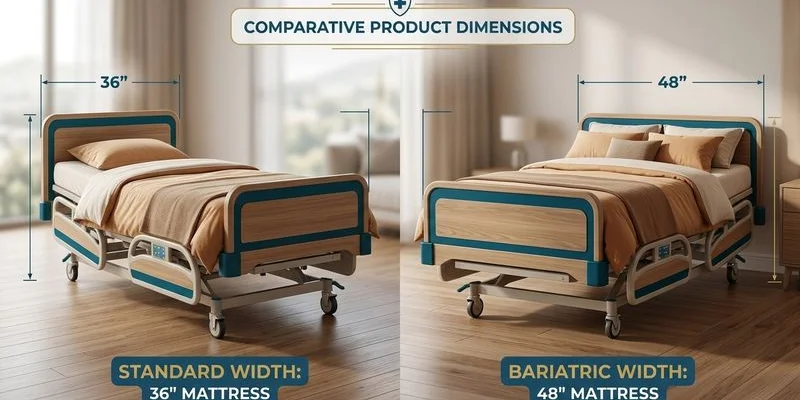
Standard hospital bed dimensions are surprisingly consistent across major manufacturers. The standard bed deck width for a home hospital bed is 36 inches, with a length of 80 inches. Our standard units typically support a safe working load of 350 to 450 pounds.
These dimensions accommodate most adults comfortably and theoretically fit through standard interior doorways. The complete footprint of the bed is larger than the mattress surface itself. You must account for the head and foot boards, side rails, and caster overhang.
| Bed Type | Deck Width | Deck Length | Total Width | Total Length |
|---|---|---|---|---|
| Standard | 36 in | 80 in | 39-42 in | 84-88 in |
| Full-Electric Standard | 36 in | 80 in | 40-43 in | 85-90 in |
| Bariatric (48 in) | 48 in | 80 in | 52-55 in | 85-90 in |
| Bariatric (54 in) | 54 in | 80 in | 58-60 in | 85-90 in |
| Extra-Long | 36 in | 84 in | 40-43 in | 90-94 in |
When measuring your room, always use the total dimensions as your planning baseline. Do not use the mattress dimensions for your floor plan.
Measuring Your Room
Before purchasing a hospital bed, measure the intended room carefully. You need more than just enough floor space for the bed itself. Here is what to account for to ensure safe daily operation:
Minimum Room Requirements
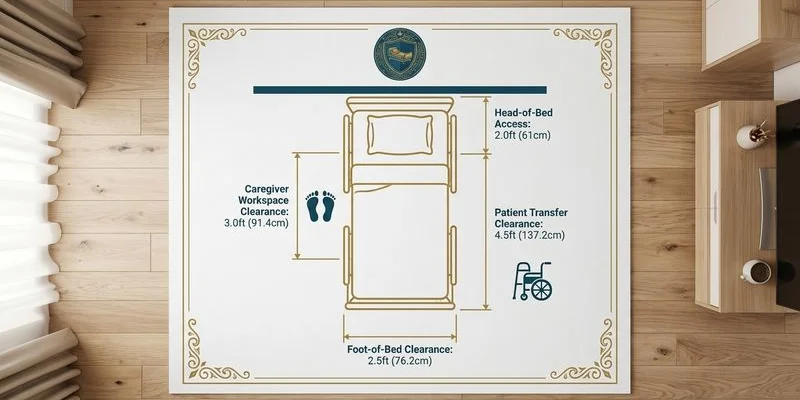
For a standard hospital bed with adequate caregiver access, your room should provide specific clearances. Business owners managing care facilities must adhere strictly to these dimensions for compliance.
- Bed footprint: At least 43 inches wide by 90 inches long
- Caregiver access on both sides: 36 inches of clearance on each side of the bed
- Foot-of-bed clearance: 36 inches beyond the foot of the bed for wheelchair access or equipment
- Doorway access: Measure every doorway between the home entrance and the room, because beds are typically brought in on their side
These measurements align with Americans with Disabilities Act (ADA) clearance requirements for accessible spaces. The ADA specifies a minimum 36-inch pathway around medical equipment. Our compliance experts note that the recent 2024 ADA updates mandate a maximum 17-inch transfer height for diagnostic equipment, making high-low adjustable beds essential for compliance leading up to the 2026 deadlines.
Ideal Room Size
For a standard hospital bed with comfortable access, we recommend a generous floor plan. This allows room for an overbed table, bedside table, and a medical chair.
- 12 feet by 12 feet (144 square feet): comfortable for most setups
- 10 feet by 12 feet (120 square feet): workable with careful furniture arrangement
- 10 feet by 10 feet (100 square feet): tight but possible for a standard bed with single-side access
If you are working with a smaller room, consider which side of the bed the caregiver will access most frequently. Prioritize clearance on that specific side to make daily tasks easier.
Patient Sizing Considerations
The bed must fit the patient just as well as it fits the room. Our team evaluates three specific physical metrics before recommending a frame. Here are the key patient measurements to consider:
Width
A standard 36-inch bed deck provides a comfortable sleeping surface for patients up to approximately 200 pounds with an average body width. Patients who are broader through the shoulders or hips may feel confined on a standard deck. Turning or repositioning becomes much more difficult for caregivers in tight spaces.
A 2012 ergonomics study in long-term care found that patients have a 51% chance of falling from a standard 35-inch mattress during a repositioning event. Upgrading to a 42-inch bariatric width reduces this fall risk by up to 36%.
Bariatric bed dimensions start at 42 inches and go up to 54 inches or wider. These extra inches make a significant difference in patient comfort and caregiver safety. See our bariatric hospital bed guide for detailed information.
Height and Length
Most adults fit comfortably on an 80-inch bed deck. Patients over six feet two inches tall require an 84-inch extra-long deck to prevent their feet from pressing against the foot board.
Our technicians see this issue frequently when a foot-elevation feature is used. Elevating the legs effectively shortens the usable sleeping area.
Weight
Mattress sizing directly relates to weight capacity. Heavier patients compress standard foam much faster, reducing both comfort and therapeutic effectiveness.
A standard home bed safely supports up to 450 pounds. Models like the Medacure or Invacare bariatric beds feature reinforced steel frames that handle 600 to 1,000 pounds.
A patient at the upper end of a standard bed’s weight capacity must use a higher-density mattress specifically rated for their weight range. This simple upgrade prevents premature mattress failure and ensures proper spinal support.
Mattress Sizing
The mattress must match both the bed frame and the patient perfectly. Standard hospital bed mattresses from brands like Transfer Master follow very specific dimensional rules.
- Width: 36 inches (standard) or 42 to 54 inches (bariatric)
- Length: 80 inches (standard) or 84 inches (extra-long)
- Depth: 6 inches to 7 inches for standard use, up to 10 inches for specialty pressure-relief
The mattress depth heavily affects the final bed height and safety. A standard consumer mattress is often 10 to 18 inches thick, but hospital mattresses are strictly 6 to 7 inches deep.
Using a thick consumer mattress restricts the bed’s articulation mechanisms. It also dangerously raises the patient above the safety rails, creating a serious fall hazard.
If your ultra-low bed is meant to bring the sleeping surface close to the floor, a thicker mattress partially defeats that purpose. For a comprehensive comparison of mattress options, read our hospital bed mattress comparison guide.
Doorway and Hallway Navigation
Getting the bed into the room is a practical challenge worth planning for in advance. Older US homes built before 1990 frequently feature interior doors as narrow as 28 inches.
Since the main bed deck is 36 inches wide, moving it fully assembled is impossible. Here is what to measure:
- Front door: Width and height (most US front doors are 36 inches wide and 80 inches tall)
- Interior doors: Width (check for narrow 28-inch bathroom or bedroom doors)
- Hallway width: Minimum clearance for bed transport on a moving dolly
- Stairways: Hospital beds are extremely difficult to move up or down stairs, making a ground-floor room highly recommended
- Turns: 90-degree hallway turns require extra clearance for long bed frames
Most hospital beds can be partially disassembled for delivery. The head board, foot board, and side rails easily detach from the deck. The bed deck itself remains the largest single piece.
Our white-glove delivery team handles all of this assembly. Measuring tricky access points before delivery day ensures a smooth installation. Bundled hospital bed packages include delivery and setup, which simplifies the entire process.
Special Sizing Scenarios
Standard rules do not apply to every situation. Our experience shows that unique patient needs require highly specific room planning.
Bariatric Patients
Patients requiring bariatric hospital beds need extra room planning. A 54-inch-wide bariatric bed with 36 inches of clearance on each side requires a room width of at least 10.5 feet (126 inches).
The reinforced frame and wider deck also increase the bed’s weight significantly. A 54-inch bariatric bed, patient, and heavy-duty frame can put 1,000 to 1,200 pounds of concentrated load on a residential floor.
You must confirm that your home’s flooring structure can support this combined weight. Reinforcing the floor joists may be necessary in older residential buildings.
Pediatric Patients
Pediatric hospital beds are much smaller in both length and width. Standard pediatric dimensions start at 30 inches wide by 60 inches long. These units feature higher safety rails to prevent falls.
Some families use standard adult beds with pediatric mattresses and specialized rail inserts. This strategy extends the usability of the frame as the child grows.
Tall Patients
For patients over six feet three inches, an extra-long 84-inch deck is strongly recommended. Some US manufacturers offer custom lengths up to 88 inches.
You must pair an extra-long bed with a matching extra-long mattress. Do not simply place a standard 80-inch mattress on an oversized deck. The resulting gap creates a severe entrapment hazard.
Room Setup Tips
Once you have confirmed the bed fits your room, you need to optimize the layout. A well-planned room improves both medical care and daily comfort. Our preferred setup strategies include:
- Position the head of the bed against a wall for stability and to create a more natural bedroom appearance.
- Place the primary caregiver access side closest to the door for a quick response during nighttime calls.
- Ensure an electrical outlet is within cord reach, because extension cords are a tripping hazard and a fire risk.
- Leave space for an overbed table to swing over the bed without hitting walls.
- Consider the 17-inch ADA transfer height rule when setting the baseline height for wheelchair transfers.
For more room setup guidance, check out our guide on setting up a home recovery room.
Getting Professional Help
If you are unsure about sizing, our team at Orlando Home Hospital Beds offers free in-home assessments. We measure your room, assess doorway access, and recommend the exact hospital bed size for your patient and space.
This service is included with every purchase and available even before you commit to buying. We hope this Hospital Bed Sizing Guide: Finding the Right Fit for Your Room and Patient helps you make a confident, informed decision.
Visit our showroom or call us today to schedule your assessment.