Hospital Bed Mattress Types Compared: Innerspring, Foam, and Alternating Pressure

We frequently see homeowners and care facility managers spend days researching bed frames while treating the mattress as an afterthought.
This oversight often leads to painful pressure injuries and sleepless nights. The actual sleeping surface dictates patient comfort and skin health far more than the frame itself. A mismatched mattress ruins the benefits of even the most advanced bed.
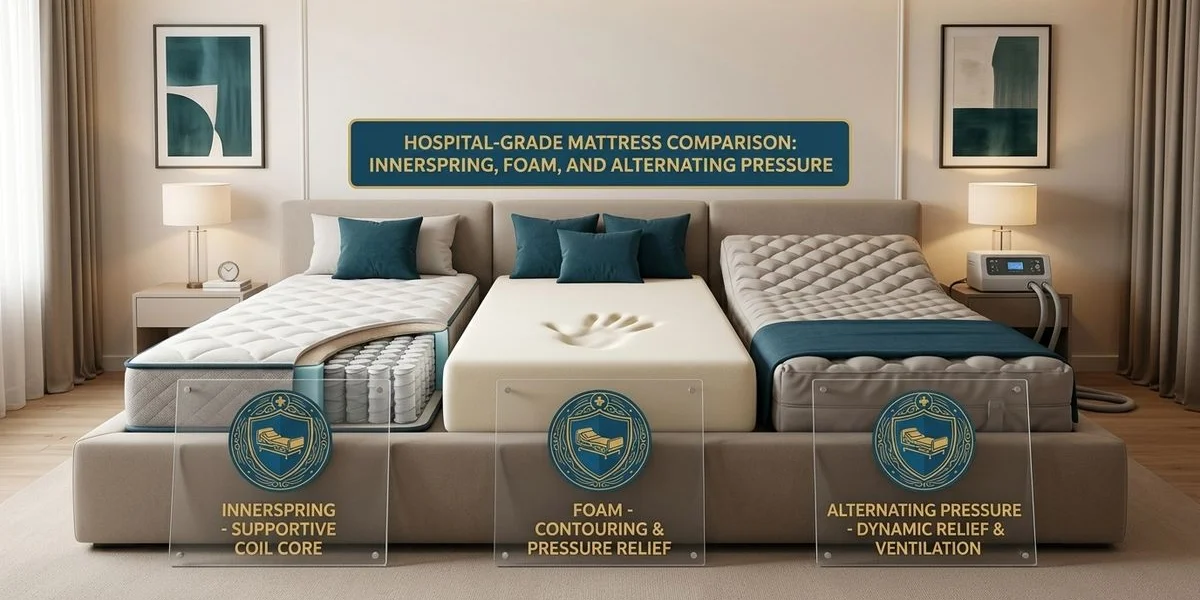
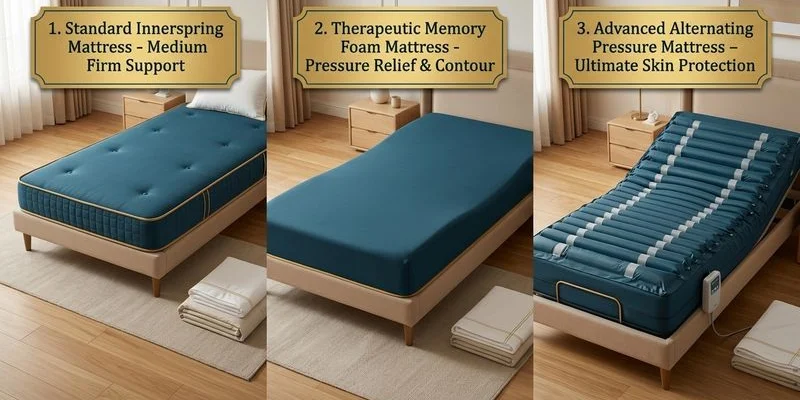
Our guide to Hospital Bed Mattress Types Compared: Innerspring, Foam, and Alternating Pressure will clarify exactly how to match the correct surface to specific medical needs. Let’s examine the data behind the three main categories and help you make a confident choice.
Innerspring Therapeutic Mattress
We always tell clients that an innerspring therapeutic mattress provides the most familiar feel for a patient transitioning to home care.
A steel coil support system sits beneath comfort layers of foam or fiber padding. This traditional setup mimics a standard residential bed beautifully. Our team recommends these primarily for users with good mobility.
Construction
- Core: Steel coil springs (typically 312 pocketed coils from brands like Invacare).
- Comfort layers: 1 to 2 inches of high-density fiber or foam padding.
- Cover: Fluid-proof nylon or vinyl for basic incontinence protection.
- Standard dimensions: 36 inches wide by 80 inches long.
- Weight capacity: Usually 250 to 350 pounds for standard consumer models.
Advantages
- Familiar feel: Most similar to a regular home mattress, which helps patients feel comfortable rather than medicalized.
- Firm support: Good for patients who need a stable surface for transfers and independent repositioning.
- Airflow: The spring structure allows excellent air circulation within the mattress, reducing heat buildup.
- Durability: Quality innerspring mattresses easily last 3 to 5 years with regular use.
- Affordability: Generally the least expensive hospital bed mattress option, typically costing between $150 and $400.
Disadvantages
- Limited pressure redistribution: Springs create focused pressure points at each individual coil contact area.
- Unsuitable for high-risk patients: Patients who are bedbound or at risk for pressure ulcers absolutely need a more advanced surface.
- Heavier weight: Weighing 25 to 40 pounds makes it difficult for a single caregiver to flip or rotate safely.
- Noise potential: Older or cheaper innerspring mattresses can squeak noticeably during patient movement.
Best For
We suggest this option for patients who are moderately mobile and can reposition themselves. Users who are not at significant risk for pressure injuries do well on these firm surfaces.
They also serve as an excellent base mattress when paired with a gel overlay. Our experience shows they often qualify as a Medicare Group 1 support surface if a physician prescribes the bed.
Foam Mattress (Therapeutic Foam)
We consider therapeutic foam mattresses to be the best middle-ground option for most home care setups. Specialized foam layers distribute the patient’s weight evenly across the bed. The performance varies enormously based on the density and type of foam utilized.
Our preferred models, like the Medline Advantage Homecare or the Drive Medical Gravity series, use multiple distinct layers to achieve this.
Types of Foam
- Standard Polyurethane Foam: Basic hospital foam provides moderate pressure redistribution. This affordable choice works perfectly for low-risk patients.
- High-Resilience (HR) Foam: Higher-density foam returns to its original shape quickly after compression. It provides much better durability than standard polyurethane.
- Viscoelastic (Memory) Foam: Temperature-sensitive foam conforms exactly to the patient’s body shape. This material represents the gold standard for pressure redistribution, with optimal density usually measuring between 4 and 6 pounds per cubic foot.
- Latex Foam: Natural or synthetic rubber foam offers excellent responsiveness and durability. This naturally antimicrobial option costs more than memory foam.
Multi-Layer Construction
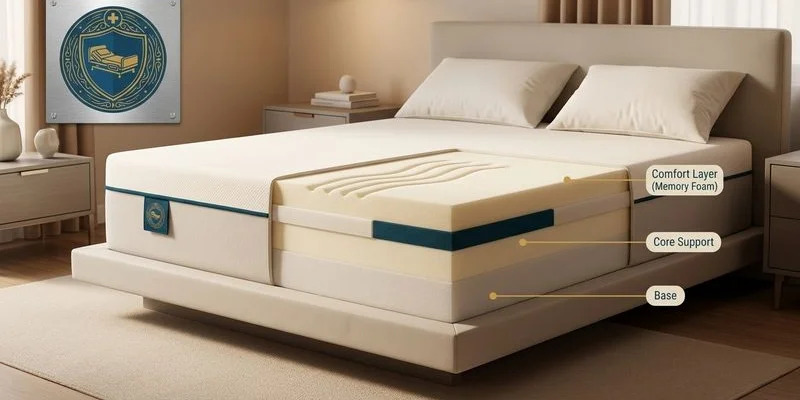
We frequently see top-tier foam mattresses utilizing a specific three-layer build.
- Base layer (4 to 5 inches): High-density firm foam provides structural support for safe patient transfers.
- Transition layer (1 to 2 inches): Medium-density foam bridges the firm bottom and the softer top layers.
- Comfort layer (1 to 2 inches): Memory foam conforms to the body for maximum skin protection.
Our research indicates that a top comfort layer, often featuring a 5-zone horizontal cross-cut design, maximizes pressure relief and reduces shear friction.
Advantages
- Superior pressure redistribution: Distributes weight across a much larger surface area than innerspring models.
- Density options: Available in multiple firmness levels to match specific patient weight and risk profiles.
- Silent operation: The complete lack of springs means absolutely no noise during movement.
- Lighter weight: Weighing 15 to 30 pounds makes it far easier for caregivers to handle during bedding changes.
- Therapeutic variety: Ranges from basic prevention surfaces to clinical-grade redistribution models.
Disadvantages
- Heat retention: Foam naturally traps body heat, which can cause discomfort in warm climates.
- Compression risk: Lower-density varieties can compress permanently over time under heavy, continuous use.
- Initial off-gassing: New foam mattresses may emit a slight chemical odor for the first 48 hours.
- Insufficient for highest risk: Patients who cannot be repositioned regularly require active alternating pressure instead.
Best For
We recommend therapeutic foam for patients at moderate risk for pressure injuries. Those who spend significant time in bed but can reposition with help are ideal candidates.
These mattresses provide a great balance of comfort and clinical support. Our clients consistently praise memory foam for preventing early-stage skin breakdown.
Alternating Pressure Mattress
We reserve the alternating pressure mattress (APM) for the most critical home care situations. This technology represents the highest level of pressure redistribution available outside a hospital setting.
The mattress actively cycles pressure across the sleeping surface instead of relying on passive foam. Our standard recommendation for severe wounds involves systems like the Blue Chip Supreme Air, which use independent air bladders.
How It Works
An electric pump inflates and deflates multiple rows of air cells on a timed cycle. The standard cycle time usually runs between 5 and 15 minutes.
When the odd cells inflate, the even cells deflate, and vice versa. This constant shifting ensures no single area of the patient’s body bears continuous pressure. Our clinical partners prefer this therapy because it directly mimics manual repositioning for patients who cannot move themselves.
Construction
- Air cells: PVC or polyurethane bladders (often 18 separate 8-inch deep cells) arranged in rows.
- Pump unit: An electric pump mounts securely to the foot of the bed frame.
- Cover: Breathable, fluid-resistant, low-shear top covers protect the patient’s skin.
- Typical thickness: 8 to 10 inches when fully inflated for maximum support.
- Weight capacity: Quality standard units comfortably support up to 350 pounds.
Advantages
- Unmatched pressure redistribution: The absolute best surface available for severe home wound care.
- Active therapy: The system works continuously and does not rely on manual patient repositioning.
- Adjustable firmness: Air pressure can easily be increased or decreased to match specific patient weight preferences.
- Moisture management: Many premium models, like the Drive Medical Med Aire, incorporate low air loss technology to control dangerous skin moisture.
- Effective wound treatment: Proven to aid healing for existing Stage 3 and Stage 4 pressure ulcers.
Disadvantages
- High cost: APMs are the most expensive category, with quality medical models ranging from $500 to over $3,000.
- Continuous noise: The pump produces a low, continuous hum that some light sleepers notice.
- Electrical dependency: Needs continuous power to function, requiring a strict backup plan for power outages.
- Surface instability: The alternating air cells create a slight rocking sensation that some patients find unsettling.
- Maintenance needs: Pump filters require routine cleaning, and individual air cells can occasionally develop leaks.
Best For
We strictly advise these systems for patients at the highest risk for pressure injuries. Individuals with existing Stage 2 ulcers that have not healed on foam need this upgrade immediately.
Medicare Group 2 coverage actually requires documentation of these specific wounds before approving an APM. Our care team also recommends them for bedbound patients who cannot tolerate manual repositioning due to pain.
Head-to-Head Comparison
| Factor | Innerspring | Foam | Alternating Pressure |
|---|---|---|---|
| Pressure Redistribution | Basic | Good to Excellent | Best |
| Comfort | Familiar | Excellent | Good (some motion) |
| Noise | Possible squeaks | Silent | Pump hum |
| Heat | Good airflow | Can trap heat | Good with low air loss |
| Durability | 3 to 5 years | 2 to 4 years | 3 to 5 years (cells + pump) |
| Weight | 25 to 40 lbs | 15 to 30 lbs | 15 to 25 lbs (+ pump) |
| Price Range | $150 to $400 | $200 to $800 | $500 to $3,000+ |
| Maintenance | Low | Low | Moderate (pump + cells) |
| Best Risk Level | Low | Low-Moderate | Moderate-High |
Choosing the Right Mattress
We emphasize a careful, step-by-step evaluation process for every client. A structured approach prevents costly mistakes and ensures patient safety.
The Braden Scale serves as the primary medical tool for this assessment. Our detailed breakdown below helps you apply these medical scores directly to your purchasing decision.
Step 1: Assess Risk Level
Healthcare providers rely on the Braden Scale to predict pressure injury risk. You should always ask your doctor for this specific score before shopping.
- No Risk (Braden 19-23): Standard innerspring works fine for basic comfort.
- Mild Risk (Braden 15-18): Basic therapeutic foam provides appropriate protection.
- Moderate Risk (Braden 13-14): Premium memory foam is highly recommended to prevent breakdown.
- High to Severe Risk (Braden 12 or below): An alternating pressure mattress is an absolute requirement.
Step 2: Consider Mobility
- Independent movement: If the patient can reposition themselves, choose a firm innerspring or basic foam model.
- Assisted movement: If the patient needs help to turn, select a multi-layer foam or an alternating pressure system.
- Restricted movement: If the patient cannot be repositioned due to severe pain or medical restrictions, invest in an alternating pressure mattress immediately.
Step 3: Consider Duration
- Short-term use (weeks): An innerspring is perfectly adequate for temporary, low-risk healing.
- Medium-term use (months): High-quality foam provides a reliable, daily balance of comfort and skin protection.
- Long-term use (years): Invest in the absolute best mattress the patient’s highest potential clinical risk level requires.
Step 4: Consider Budget
- Under $300: Quality innerspring or a very basic polyurethane foam.
- $300 to $800: Premium therapeutic foam featuring advanced multi-layer construction.
- $800 to $3,000+: Advanced alternating pressure systems complete with low air loss features.
Mattress and Bed Compatibility
We frequently see families make dangerous mistakes by pairing the wrong mattress with a hospital frame. Standard household mattresses simply do not fit medical beds.
A standard consumer Twin XL measures 38 inches wide, while a standard hospital bed requires exactly 36 inches. Our safety audits show that this two-inch difference creates a hazardous gap where a patient’s limb can become trapped against the side rails.
Always verify these exact specifications to ensure safety:
- Width: Standard is exactly 36 inches, while bariatric models range from 42 to 54 inches.
- Length: Standard is 80 inches, and extra-long beds require a specific 84-inch mattress.
- Depth: Check that the total height works for your specific transfer needs, which is especially critical for ultra-low beds.
- Weight: Confirm the chosen mattress weight falls safely within the frame’s rated accessory capacity.
Our hospital bed packages pair completely compatible beds and mattresses together. This bundled approach eliminates dangerous sizing guesswork entirely.
For help choosing between electric bed types, read our comparison of fully-electric versus semi-electric hospital beds. You can find more details in our complete buying guide or explore specific frame types like fully-electric beds and bariatric beds.
We encourage you to contact our US-based team for personalized assistance.
Finding the correct support surface requires careful consideration of clinical needs and budget constraints. Let us help you select a safe, comfortable mattress that protects your loved one effectively.