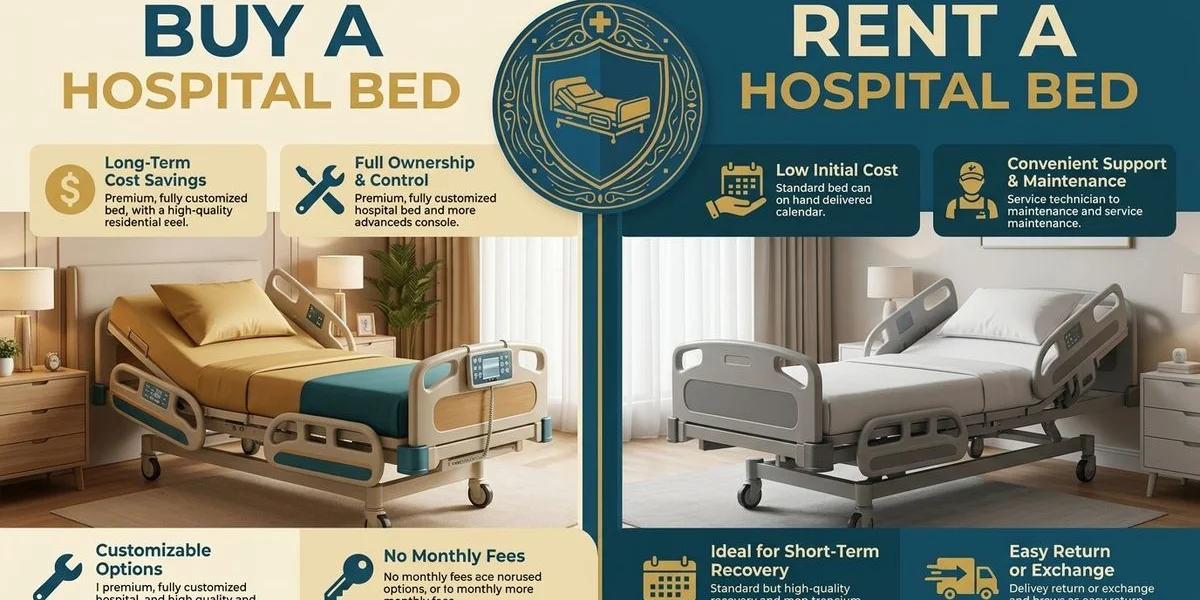
Hospital Bed Financing Options: Payment Plans That Work for Your Family


Our team understands that a hospital bed is a significant investment in your loved one’s care, comfort, and safety. Current US pricing ranges from around $500 for a basic manual model to well over $2,500 for a quality full-electric bed. Premium luxury models with advanced features can easily reach $8,000 or more.
We regularly speak with families who are focused on how to afford this necessary equipment without financial strain. The good news is that exploring hospital bed financing options will reveal payment plans that work for your family.
This guide breaks down the real costs, explains what the data actually means for your budget, and provides practical ways to respond.
Hospital Bed Financing Options: Payment Plans That Work for Your Family
According to recent industry data, a massive percentage of home medical equipment is financed rather than purchased outright. Financing allows you to preserve cash reserves while securing immediate access to items like a $3,000 adjustable bed.
1. In-Store Payment Plans
Many medical equipment retailers, including Orlando Home Hospital Beds, offer healthcare payment plans that let you spread the cost over several months. Third-party services like Affirm or Synchrony Financial frequently partner with stores to provide these point-of-sale options. You can typically choose terms that span anywhere from three to twelve months.
Our specialists find this is often the simplest approach because everything is handled directly at the checkout counter. These plans generally feature:
- No or low interest during a promotional period.
- Fixed monthly payments that fit your household budget.
- Soft credit checks that do not impact your FICO score.
- Immediate delivery so you receive the bed right away.
You simply select your desired model, agree to the terms, and the store schedules your delivery.
2. Healthcare Credit Cards
Specialized healthcare credit cards like CareCredit, Prosper Healthcare Lending, and Alphaeon Credit are explicitly designed for medical expenses. They offer promotional financing periods of 6, 12, 18, or 24 months at 0% interest for purchases over $200. These cards provide higher credit limits than standard consumer cards and feature instant online approval decisions.
We want to highlight a critical warning regarding deferred interest with these specific cards. If you carry a balance past the promotional period, a staggering 32.99% standard annual percentage rate kicks in. This interest is applied retroactively to the original purchase date. Plan your payment schedule carefully to ensure the balance reaches zero before the promotion expires.
3. HSA and FSA Funds
If you or your spouse has a Health Savings Account (HSA) or Flexible Spending Account (FSA), hospital beds qualify as an eligible medical expense under IRS Publication 502. For the 2026 tax year, the IRS increased HSA contribution limits to $4,400 for individuals and $8,750 for families. Using these pre-tax dollars effectively creates a 20% to 35% discount based on your current tax bracket.
Our clients often use existing HSA balances that have rolled over from previous years to cover these large purchases. Unlike FSAs, HSA funds do not expire at the end of the calendar year. For a $2,500 hospital bed, paying with pre-tax funds saves roughly $500 to $875 compared to using your standard after-tax income.
4. Personal Loans
Banks, credit unions, and online lenders offer personal loans that provide a highly predictable way to fund medical equipment. According to Bankrate data from March 2026, the average personal loan interest rate in the US sits at 12.26%. Borrowers with excellent credit can often secure rates closer to 6.20% through specific online lenders like Upstart or federal credit unions.
We highly recommend checking with your local credit union first if you hold a membership there. Federal credit unions legally cap their maximum interest rates at 18%, making them a safer alternative to high-interest credit cards. A personal loan provides a fixed monthly payment over 12 to 60 months, allowing you to choose the exact bed you want without retailer restrictions.
5. Retirement Account Distributions
For retirees, taking a distribution from an IRA or 401(k) is another valid method to fund a home hospital bed. These distributions are typically treated as taxable income by the IRS. You might be able to offset some of this tax impact by itemizing your medical costs on Schedule A of your Form 1040.
Our team advises consulting a certified public accountant before making a withdrawal. The IRS currently allows taxpayers to deduct qualifying medical expenses that exceed 7.5% of their Adjusted Gross Income. Using a retirement account is best reserved for those who have ample funds and meet that specific deduction threshold.

Comparing Financing Options
We created this quick reference guide to help you view the numbers side-by-side. Choosing the right path depends entirely on your timeline, credit profile, and tax situation. Review these standard terms to make a clear, data-driven choice for your family.
| Option | Interest Rate | Timeline | Tax Benefit | Best For |
|---|---|---|---|---|
| In-Store Plans | 0% (promotional) | 3-12 months | No | Quick, simple financing |
| CareCredit | 0% (promo) then 32.99% | 6-24 months | No | Disciplined buyers needing 0% terms |
| HSA/FSA | None (pre-tax) | Immediate | 20-35% tax savings | Those with established 2026 accounts |
| Personal Loan | 6.20% - 12.26% average | 12-60 months | No | Large purchases requiring fixed rates |
| Retirement Distribution | Income tax | Immediate | Deduction if over 7.5% AGI | Retirees working with tax advisors |
Strategies to Maximize Affordability
Bundle and Save
Purchasing hospital bed packages that bundle the frame, mattress, and rails is mathematically superior to buying separate pieces. Buying individual components adds up quickly, especially when a quality alternating pressure air mattress alone can cost between $150 and $600. A standard package typically saves you 10% to 20% right off the top.
Our purchasing data shows that bundling a $2,000 setup often leaves an extra $200 to $400 in your pocket. Read our direct comparison of packages versus buying separately for a detailed breakdown of these savings. Suppliers discount these bundles because shipping everything on a single pallet reduces their freight costs.
Buy What You Need Now, Upgrade Later
If your current budget is strict, start by securing a solid fully-electric hospital bed with a standard therapeutic foam mattress. These foundational components handle the most immediate medical and safety requirements. You do not have to purchase every available luxury accessory on day one.
We regularly help customers plan phased upgrades over several months. Items like a specialized overbed table or a heavy-duty Trapeze bar, which typically costs $100 to $300, can be easily attached later. This strategy prevents you from taking on unnecessary debt while still providing excellent care.
Consider the Total Cost of Ownership
Evaluating a bed solely by its sticker price is a common and expensive mistake. A basic $500 manual bed that requires constant repairs costs much more in the long run than a $2,500 model from a trusted brand like Hill-Rom or Invacare. You must factor in longevity, warranty coverage, and annual maintenance.
Our technicians note that standard maintenance plans run about $100 to $150 per year. Investing in a highly rated bed with a comprehensive five-year warranty eliminates surprise repair bills. Quality electric motors and reinforced steel frames easily last a decade, making the slightly higher upfront price a better financial decision.
Compare Insurance Plus Private Pay
Do not assume that insurance will cover a premium bed or that private pay is your only option. Medicare Part B frequently covers 80% of the allowable cost for basic equipment if a doctor deems it medically necessary. This leaves you responsible for the remaining 20% copay.
We encourage families to use private financing to cover that remaining balance or to fund upgrades that insurance rejects. Combining a partial insurance reimbursement with a personal loan severely reduces your total out-of-pocket burden. Review our private pay versus insurance guide for precise strategies on blending both payment types.
What Not to Do
Do Not Delay Essential Care for Financial Reasons
Putting off a necessary purchase because of budget constraints creates medical risks that dwarf the price of the equipment. Without proper side rails and adjustable heights, the risk of falls increases exponentially. Falls remain the leading cause of fatal and non-fatal injuries for older Americans.
Our clinical partners also warn about the massive costs associated with treating pressure ulcers. A severe Stage 4 pressure sore can cost thousands of dollars to treat in a clinical setting. Securing a bed with a pressure-relief mattress immediately is far cheaper than paying for prolonged hospital readmissions.
Do Not Use High-Interest Credit Cards
Placing a large medical purchase on a standard credit card is a mathematically poor decision. The average US credit card interest rate hovered around 22.3% heading into 2026. If you put a $3,000 bed on a card at that rate and make only minimum payments, the final cost will easily surpass $5,000 over several years.
We strongly advise utilizing a 0% promotional option or a standard personal loan instead. A personal loan at the current 12.26% average rate will save you a substantial amount of money compared to a standard Visa or Mastercard. Protect your long-term finances by matching the right credit product to the purchase size.
Do Not Overspend on Features You Do Not Need
A premium luxury bed is an excellent piece of equipment, but aspirational features are not strictly required for good health. Functions like built-in massage motors, under-bed lighting, or integrated digital scales are fantastic conveniences. A standard fully-electric bed easily handles 90% of home mobility needs perfectly.
Our staff will always point you toward the equipment that matches your specific medical requirements. Do not feel pressured to spend $5,000 on an ICU-style model if a $1,500 standard electric bed keeps your loved one safe and comfortable. Spend your budget on the features that directly improve daily care.
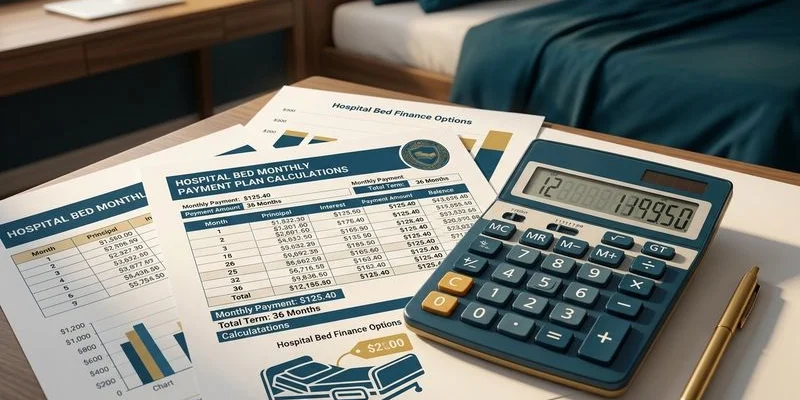
Getting Started with Financing
At Orlando Home Hospital Beds, we respect every family’s unique budget constraints. You do not have to figure out this process alone. Here is the exact framework our specialists use to get you set up quickly:
- Select your bed: We help you identify the right model, whether that is a standard fully-electric bed, a heavy-duty bariatric bed, or a bundled hospital bed package.
- Review financing options: You will see all available payment plans, including Affirm or CareCredit terms, to find the perfect monthly fit.
- Apply securely: The majority of online and in-store applications process in minutes with instant approval decisions.
- Receive your bed: Once the paperwork clears, our team schedules a prompt white-glove delivery, often within a few days.
We ensure that cost never permanently blocks your loved one from receiving proper care.
Conclusion
Between in-store point-of-sale plans, healthcare credit cards, and pre-tax HSA funds, a reliable payment solution exists for your situation. There is almost always a mathematical path to make the exact bed you need affordable.
Take control of your home care setup today. Visit our Orlando showroom or call our dedicated team to discuss your specific requirements and lock in hospital bed financing options and payment plans that work for your family.