Fully-Electric vs Semi-Electric Hospital Beds: Which Is Better for Home Use?

Our professional service team fields questions about home medical equipment every single day. You probably already know that setting up a room for patient care at home involves balancing comfort with practicality.
Deciding on fully-electric vs semi-electric hospital beds: which is better for home use?
Our experience shows that this choice completely changes the daily care routine. The actual difference boils down to how the bed changes height. That one mechanical detail directly impacts fall risks, caregiver back health, and long-term costs.
We will break down exactly how they operate and review the real-world financial factors. Let’s look at the current 2026 data on these two options so you can make the smartest choice.
How Each Type Works
Fully-Electric Hospital Beds
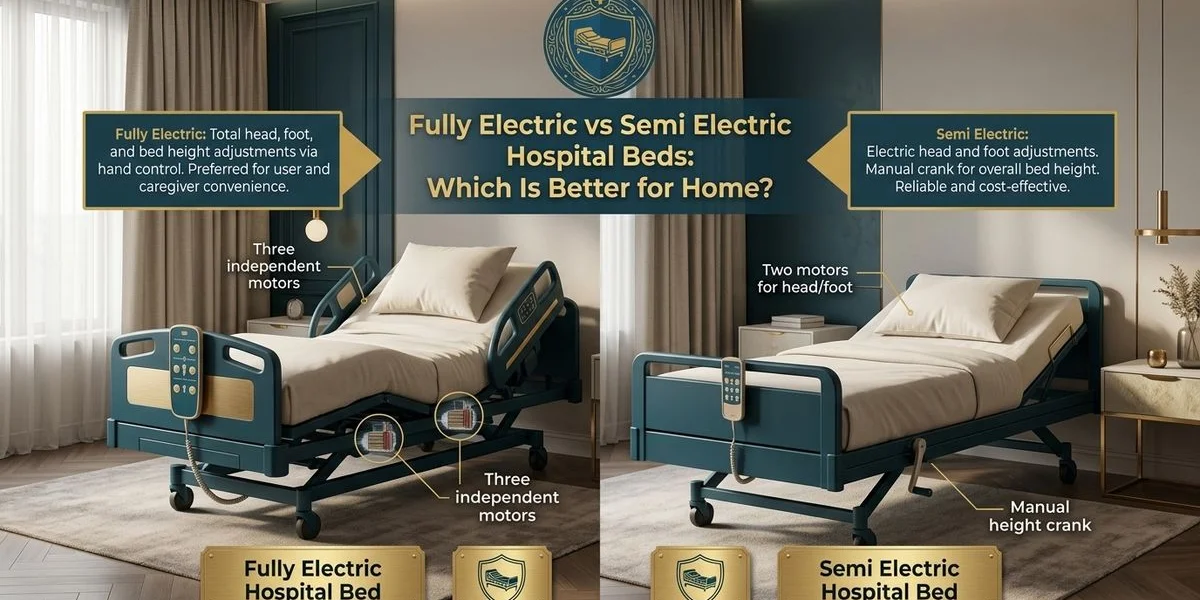
A fully-electric hospital bed uses a dual-motor actuator system to power all three primary adjustments. We regularly see premium models utilizing advanced LINAK or Dewert sealed linear actuators for this task. These high-end motors operate at a whisper-quiet 49 to 52 decibels, which is about as quiet as a humming refrigerator.
- Head section elevation: Raises and lowers the upper body.
- Foot section elevation: Raises and lowers the legs.
- Complete bed height (Hi-Lo): Raises and lowers the entire sleeping surface.
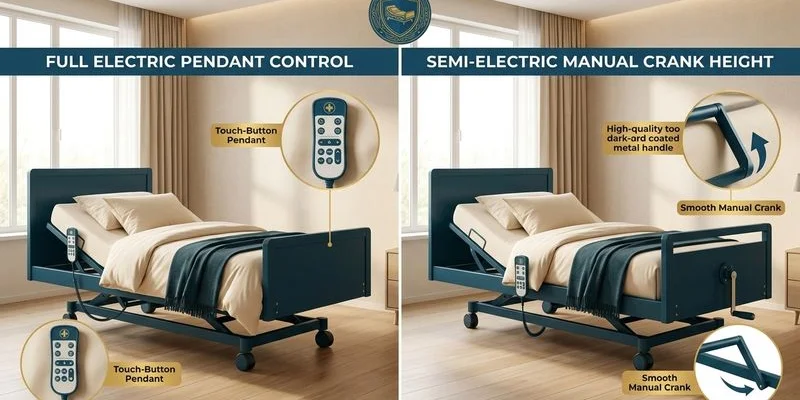
Every adjustment happens through a wired or wireless pendant hand control. The patient can independently adjust their position without calling for help. Caregivers can make adjustments without physical effort, prioritizing safety during transfers.
Our team recommends checking the specific height ranges before buying. Most models easily lower to a safe 10 to 16 inches off the ground or raise to 30 inches for comfortable care.
Semi-Electric Hospital Beds
A semi-electric hospital bed uses electric motors for the head and foot sections but relies on a manual crank adjustment for the complete bed height. Our installers usually point out the crank located at the foot of the bed. It requires several physical turns to raise or lower the bed surface.
The patient can still adjust their head and foot position independently using a remote. Changing the bed height requires someone to physically crank the mechanism.
We find this physical requirement changes the entire dynamic of providing care. It takes about 30 to 60 seconds to crank the bed up or down.
Feature-by-Feature Comparison
| Feature | Fully-Electric | Semi-Electric |
|---|---|---|
| Head Adjustment | Electric (pendant) | Electric (pendant) |
| Foot Adjustment | Electric (pendant) | Electric (pendant) |
| Height Adjustment | Electric (pendant) | Manual crank |
| Patient Independence | Full | Partial (cannot adjust height) |
| Caregiver Effort | Minimal | Moderate (height cranking) |
| Motor System | Dual/triple motor | Single/dual motor |
| Noise Level | 49-52 dB (Premium models) | Varies by quality |
| Price Range | $1,200 - $5,000+ | $800 - $1,800 |
| Medicare Coverage | Rarely covered (HCPCS E0265) | Covered with proof (HCPCS E0260) |
| Weight Capacity | 450-500 lbs (Premium) | 350 lbs (Standard DME) |
The Height Adjustment Question
The primary difference between these two options comes down to one single function. That function is height adjustment. This detail sounds minor until you understand how frequently the bed height changes during daily home care.
When Height Adjustment Matters Most
The height adjustment feature proves critical in several daily scenarios:
- Patient Transfers: The mattress height must match the surface the patient transfers to. A standard wheelchair seat sits at roughly 19 to 20 inches high. The patient’s feet should reach the floor flat with knees at a 90-degree angle for a safe standing transfer.
- Caregiver Ergonomics: The bed should sit at the caregiver’s waist height when providing hands-on care like bathing or changing sheets. Recent 2025 statistics from the National Alliance for Caregiving show that 45% of family caregivers report high physical strain. The U.S. Bureau of Labor Statistics also reported over 248,000 back injury cases in private industry during 2024.
- Fall Prevention: Lowering the bed at night reduces fall injury risks. Ultra-low fully-electric beds can drop to just 7 to 10 inches off the floor. We consider this a mandatory safety feature for patients with severe mobility issues. Our hi-lo adjustable beds offer the widest height range for both safe transfers and nighttime fall prevention.
- Night Emergencies: A fully-electric bed adjusts to the perfect working level in 10 to 15 seconds if a patient needs urgent assistance at night. Fumbling with a manual crank in a dark room at 3 AM creates unnecessary stress.
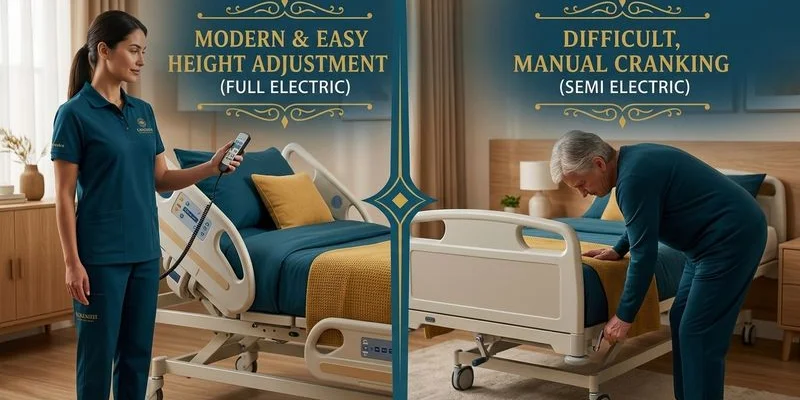
With a fully-electric bed, you press a button to handle all these situations instantly. A semi-electric bed turns these simple adjustments into a physical chore.
We see many caregivers skip the manual cranking process because it takes too much time. This frequent skipping leaves the bed at an unsafe height.
The Pendant Hand Control Experience
Both bed types use a pendant hand control for their electric adjustments. The quality and design of these remotes vary heavily between manufacturers and price points.
Basic Pendants
Simple membrane-button controls feature basic icons indicating each function. These functional remotes often ship with semi-electric beds and budget fully-electric models. They can be confusing to operate in low light.
Backlit Pendants
The buttons illuminate in the dark to make nighttime adjustments easy. We recommend these for anyone handling overnight care. They come standard on mid-range and premium fully-electric beds.
Wireless Pendants
These remotes have no cord to tangle or drop. They communicate with the bed via radio frequency. Premium models include this feature, which is highly useful for patients with limited hand dexterity.
Caregiver Lock
Certain advanced pendants allow the caregiver to lock specific functions. They can prevent the patient from adjusting the height while still allowing head and foot adjustments.
Our specialists find this feature incredibly useful for patients with dementia who might accidentally lower the bed to an unsafe position. It gives the caregiver complete control over the environment.
Motor Quality and Reliability
The motors inside a hospital bed represent its most critical mechanical components. Both bed types use motors, but fully-electric beds require more advanced systems.
Linear Actuator Motors
Quality hospital beds use sealed linear actuator motors. These self-contained units enclose the motor, gearing, and push rod in a single housing.
We frequently install top-tier brands like LINAK that feature an IPX6 Washable rating. This rating protects the internal components from moisture and fluid damage.
Benefits of these sealed actuators include:
- Quiet operation without grinding noises
- Long life due to dust and moisture resistance
- Smooth movement using precision gearing
- Reliable performance with fewer exposed parts
Motor Count
- Semi-electric: 1 to 2 motors for head and foot adjustments.
- Fully-electric: 2 to 3 motors to handle the head, foot, and height.
Quality actuators are rated for 10,000 or more cycles and rarely fail during the bed’s useful life. The massive convenience of electric height adjustment far outweighs the negligible reliability difference of having one extra motor.
Cost Analysis
Upfront Price
Semi-electric beds typically cost $400 to $1,500 less than comparable fully-electric models. We have watched this price gap narrow significantly over the last few years as manufacturing costs have dropped. A reliable fully-electric model now offers much better value.
Long-Term Value
Your time and physical health have tremendous value. An electric height adjustment easily saves two minutes per transfer. A patient averaging four transfers per day saves the caregiver roughly 49 hours per year.
A paid caregiver charging $20 per hour represents $980 in labor savings annually. Family caregivers receive the direct benefit of reduced fatigue and minimized back strain.
Insurance Coverage
Medicare Part B categorizes hospital beds as Durable Medical Equipment (DME). They typically cover 80% of the cost for semi-electric beds under HCPCS code E0260 after you meet your annual deductible. The standard Medicare deductible sits at $257 in 2025.
Medicare rarely covers fully-electric models. They classify the electric height adjustment as a convenience feature rather than a strict medical necessity. This restriction makes semi-electric the default choice for families relying entirely on insurance coverage.
Private-pay families can choose based purely on features and budget. For a deeper look at the insurance question, see our guide on private pay versus insurance.
Who Should Choose Fully-Electric
A fully-electric bed is the superior choice for specific home care scenarios:
- The patient transfers frequently: Multiple transfers daily make electric height adjustment essential.
- The caregiver has back issues: Manual cranking adds strain to an already physically demanding role.
- The patient lives alone: They can adjust all positions independently without waiting for help.
- The patient has cognitive impairment: Quick, quiet height changes happen without the disturbance of cranking.
- Fall prevention is a priority: Consistent bed lowering at night requires an effortless height adjustment.
- The bed will be used long-term: The convenience easily pays for itself over months and years.
- The family is purchasing privately: There are no insurance restrictions limiting the choice.
Who Should Choose Semi-Electric
A semi-electric bed makes sense under a different set of circumstances:
- Insurance is covering the bed: The fully-electric model is not approved by the provider.
- Budget is the primary constraint: Immediate out-of-pocket costs must remain as low as possible.
- Height adjustment is rarely needed: The patient does not transfer frequently, leaving the bed at one height.
- The need is strictly short-term: A few weeks of recovery makes the cost difference matter more than convenience.
- A second caregiver is always present: The physical effort of cranking is shared between two people.
Our Recommendation
We recommend a fully-electric hospital bed for the vast majority of home care situations. The daily convenience, safety upgrades, and ergonomic benefits of an electric height adjustment impact every single shift.
The price difference feels modest when you factor in the massive improvement in caregiver quality of life.
A semi-electric bed remains a perfectly functional and safe choice when strict budget constraints require it. The electric head and foot adjustments still provide the most critical positioning capabilities for patient comfort.
The manual height crank works reliably, even if it requires more physical effort.
Explore our selection of fully-electric hospital beds or visit our complete buying guide for a comprehensive overview of all bed types.
Our Orlando showroom has both fully-electric and semi-electric models available for hands-on comparison. You will notice the difference the moment you use both options.