Buy vs Rent a Hospital Bed: Which Option Is Right for You?

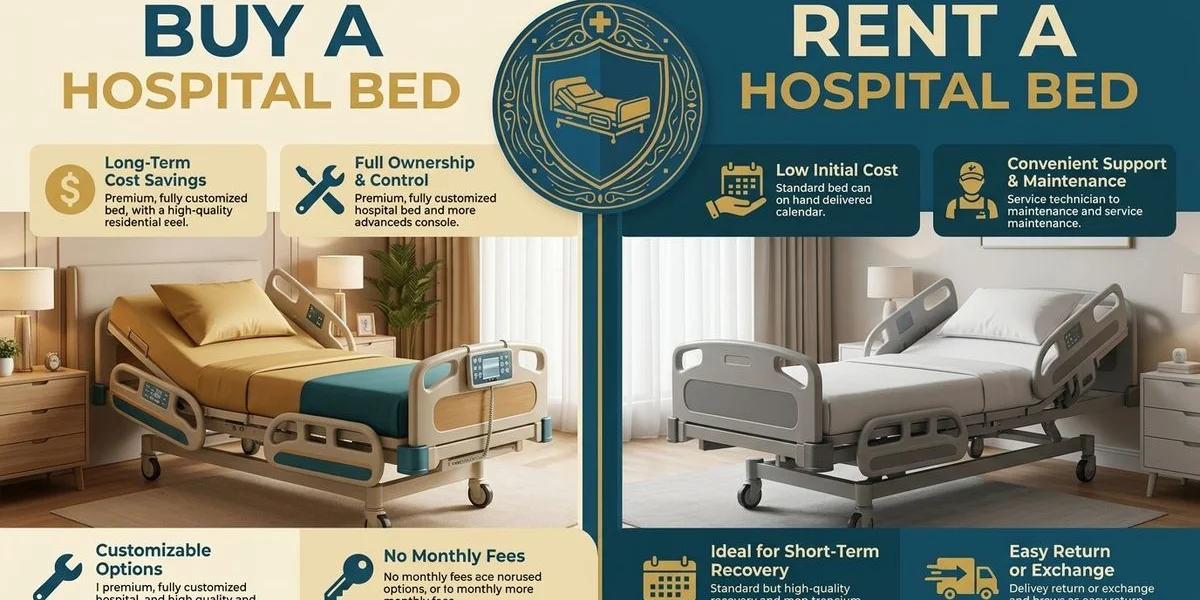
We know the decision to secure a medical bed usually happens during a stressful transition. Answering the primary question, “Buy vs Rent a Hospital Bed: Which Option Is Right for You?”, requires looking past the monthly price tag.
Our team at Orlando Home Hospital Beds has guided countless families and care facility owners through this exact calculation.
The real math involves equipment quality, total cost of ownership, flexibility, and the hidden fees that catch people off guard. We will break down current market data, highlight common pitfalls, and provide a clear roadmap for your decision.
How Medical Equipment Rental Works
Medical equipment rental typically follows one of two models in the US.
Insurance-Based Rental (Medicare DME)
Our clients often assume Medicare will simply buy them a new bed. The reality is that Medicare Part B structures this as a capped 13-month rental program for Durable Medical Equipment (DME). We want you to understand exactly how this process works under the current guidelines.
- Your physician prescribes the bed as a medical necessity.
- You obtain prior authorization from Medicare.
- A Medicare-enrolled DME supplier delivers a standard semi-electric bed.
- You meet the annual Part B deductible ($257 in 2025/2026).
- You pay a 20% coinsurance (typically $50 to $120 per month) for a 13-month rental-to-own period.
- Medicare continues to cover maintenance for the remainder of a 5-year period.
Our analysis of 2026 US market data shows your out-of-pocket cost through Medicare typically runs $650 to $1,560 over those 13 months. A crucial detail is that Medicare rarely covers full-electric models. We see many families surprised when a basic, semi-electric bed arrives instead of the fully adjustable model they expected.
Private Rental
You can bypass insurance entirely by using a direct private rental program. Our research indicates you should expect the following average fees in the US market based on 2026 pricing surveys:
- Monthly rental fee: $195 to $400 per month for full-electric models.
- Delivery and setup fee: $100 to $300 upfront.
- Pickup fee: $25 to $150 when returning the equipment.
- Damage deposit: $200 to $500 (refundable).
We appreciate that private rentals offer flexibility and faster delivery times. Finding a high-quality bed is easier this way, but forum discussions on sites like AgingCare consistently warn that rental mattresses are usually basic innerspring models. Our experience confirms that upgrading a rental mattress will increase your monthly bill significantly.
How Buying Works
We always remind clients that purchasing a home hospital bed means paying the full price upfront or using financing to own the equipment immediately. This path eliminates monthly rental agreements, strict return logistics, and used-equipment hygiene concerns. Our current market data shows purchase prices for home hospital beds range widely based on features:
- Manual beds: $500 to $1,000
- Semi-electric: $800 to $1,500
- Fully-electric: $1,200 to $6,000+ (e.g., premium Invacare models)
- Bariatric: $2,500 to $6,000+
- Premium luxury: $3,999 to $8,999+ (e.g., SonderCare residential designs)
- Packages with accessories: $1,500 to $4,000+
You must also budget for a proper mattress when buying. We advise clients that a specialized pressure-redistribution mattress will add anywhere from $200 to over $3,000 to the total purchase price.
The Total Cost of Ownership Comparison
Our favorite way to evaluate this decision is by calculating the total cost of ownership. This metric accounts for every dollar spent over the life of the equipment. We break down the math using average 2026 US pricing to show exactly where the break-even points occur.
Scenario 1: 6-Month Need (Post-Surgical Recovery)
Financial discussions on caregiver platforms highlight that the break-even point between renting and buying usually hits around six to nine months. We created this side-by-side comparison to illustrate a typical six-month recovery timeline.
| Expense Category | Rental | Purchase |
|---|---|---|
| Monthly cost | $200/month x 6 | N/A |
| Delivery/setup | $150 | Included |
| Pickup fee | $100 | N/A |
| Purchase price | N/A | $2,000 |
| Resale value | N/A | -$800 (40% recovery) |
| Total cost | $1,450 | $1,200 |
Our clients are often surprised that purchasing and reselling costs less than renting even for a six-month need. You also benefit from using a brand-new, higher-quality bed during that critical recovery window.
Scenario 2: 12-Month Need
We see the financial balance shift dramatically at the one-year mark. A continuous 12-month rental essentially buys the bed for the medical supply company.
| Expense Category | Rental | Purchase |
|---|---|---|
| Monthly cost | $200/month x 12 | N/A |
| Delivery/setup | $150 | Included |
| Pickup fee | $100 | N/A |
| Purchase price | N/A | $2,000 |
| Resale value | N/A | -$700 (35% recovery) |
| Total cost | $2,650 | $1,300 |
Our data shows that the rental cost has exceeded the net purchase cost by more than double at twelve months.
Scenario 3: 24+ Months (Long-Term/Aging in Place)
We strongly recommend purchasing for any chronic condition or aging-in-place scenario. A 2025 Benchmark Report by BFMV confirmed that used medical equipment holds its value remarkably well over several years.
| Expense Category | Rental | Purchase |
|---|---|---|
| Monthly cost | $200/month x 24 | N/A |
| Delivery/setup | $150 | Included |
| Pickup fee | $100 | N/A |
| Purchase price | N/A | $2,000 |
| Total cost | $5,050 | $2,000 |
Our long-term care clients save thousands of dollars by avoiding multi-year rental traps.

Beyond Cost: Quality Differences
We want to highlight that rental beds are used equipment by definition. These frames have been in other patients’ homes, endured multiple assembly cycles, and accumulated mechanical wear. Our preferred US rental partners maintain and sanitize their fleets rigorously. A rental bed is simply never going to match the condition and clinical performance of a new purchase.
What You Get When You Rent
Our experience shows that the standard rental inventory prioritizes durability over comfort. You are typically restricted to whatever the local DME supplier has in stock that day.
- A functional but basic semi-electric bed
- A standard innerspring or foam mattress
- Side rails with visible wear and tear
- No choice of brand, model, or custom features
- Equipment shared with previous patients
What You Get When You Buy
We know that a proper bed significantly reduces caregiver strain. A 2020 biomechanical study by Budarick et al. demonstrated that electrically adjustable beds actively reduce lumbar compression and perceived exertion during patient handling.
- The exact bed you choose with specific features
- A brand-new pressure-redistribution mattress
- Pristine side rails, pendant controls, and accessories
- A multi-year manufacturer warranty (often 5 years on the frame)
- Fully-electric, bariatric, ultra-low, or luxury options
The Flexibility Factor
Our competitors frequently cite flexibility as the primary reason to rent. This argument makes sense on the surface because you can return the equipment when the need ends. We ask our clients to consider a few practical realities about flexibility in the US market:
- Purchased beds can be resold. Hospital beds hold their value exceptionally well on the secondary market. A $2,000 bed can typically recover $600 to $1,000 on medical resale sites or local marketplaces.
- Mattress laws complicate resale. Most US states prohibit the sale of used mattresses for hygiene reasons, meaning you will likely only sell the frame.
- Rental returns require coordination. You must schedule a pickup, wait at home during broad service windows, and sometimes pay a return fee of up to $120.
- Agreements lock you in. Some rental contracts mandate a minimum 3-month billing cycle regardless of your actual usage.
Situations Where Renting Makes Sense
We acknowledge that renting is the superior choice in specific scenarios despite the long-term math. Temporary leases work beautifully for short rehabilitations.
Very Short-Term Needs (Under 3 Months)
You should rent if the patient requires a bed for a brief, predictable recovery window. We see this most often with standard hip replacement rehabilitation.
Uncertain Duration
We suggest renting when the care timeline is completely unpredictable, such as waiting for a nursing facility placement. Extending an uncertain period past six months is the most common point where families regret not purchasing.
Financial Constraints
You might find that buying a bed is simply not possible right now. If financing options are unavailable, renting gets the essential equipment into your home immediately. We frequently remind families that medical thrift stores are another excellent option for finding low-cost donated beds in the local community.
Insurance-Covered Rental
We advise clients to utilize their benefits if insurance covers the rental with a minimal copay. You have no financial reason to purchase out of pocket if a standard semi-electric model meets all clinical requirements. For a detailed comparison of the insurance and private-pay paths, read our guide on private pay versus insurance for hospital beds.
The Hidden Costs of Renting
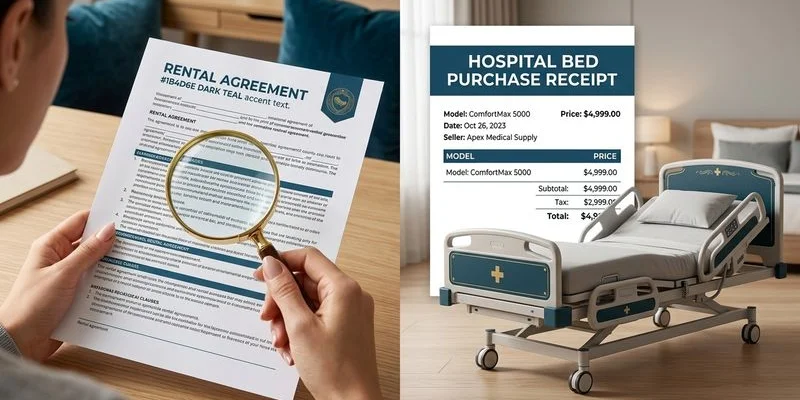
Our team reviews hundreds of rental contracts, and the fine print always contains additional expenses. You must factor these hidden fees into your monthly budget calculations:
- Setup and delivery fees ranging from $100 to $300 upfront
- Pickup fees averaging $25 to $120 when you return the frame
- Damage charges for standard mechanical wear and tear
- Lost deposit disputes during the final return inspection
- Automatic renewal clauses requiring a 30-day advance cancellation notice
- Accessory upgrades for items like overbed tables or premium mattresses
Making Your Decision
We built a simple decision framework based on the most common care scenarios in the US. The goal is to make your choice as clear as possible.
Buy if:
- The care plan extends beyond 3 to 6 months
- You require a fully-electric bed for caregiver safety
- Infection control and new equipment are top priorities
- You want to select a specific pressure-relieving mattress
- You have the funds to purchase outright or finance comfortably
Rent if:
- The recovery timeline is under 3 months and definitively ending
- Medicare Part B covers the cost with a manageable 20% coinsurance
- A basic semi-electric frame satisfies all medical needs
- Upfront purchasing is impossible and financing is declined
Not sure? We recommend starting with a purchase if you are on the fence. You can resell the bed frame on the secondary market if the need ends early. Our records show you will never recover a single dollar spent on monthly rental fees.
Next Steps
If you decide that purchasing makes the most financial sense, explore our hospital bed packages for the best value. Our complete buying guide will walk you through every technical specification and mattress option. You can also review our detailed breakdown of payment plans and financing options to manage the upfront investment.
At Orlando Home Hospital Beds, our specialists help families make this decision every single day. Visit our showroom to see the difference between rental-quality and purchase-quality equipment firsthand.
We will help you find the right solution for your caregiving timeline, budget, and clinical requirements.